Progressive null-tracking for volumetric rendering
In ACM SIGGRAPH Conference Papers, 2023
Abstract
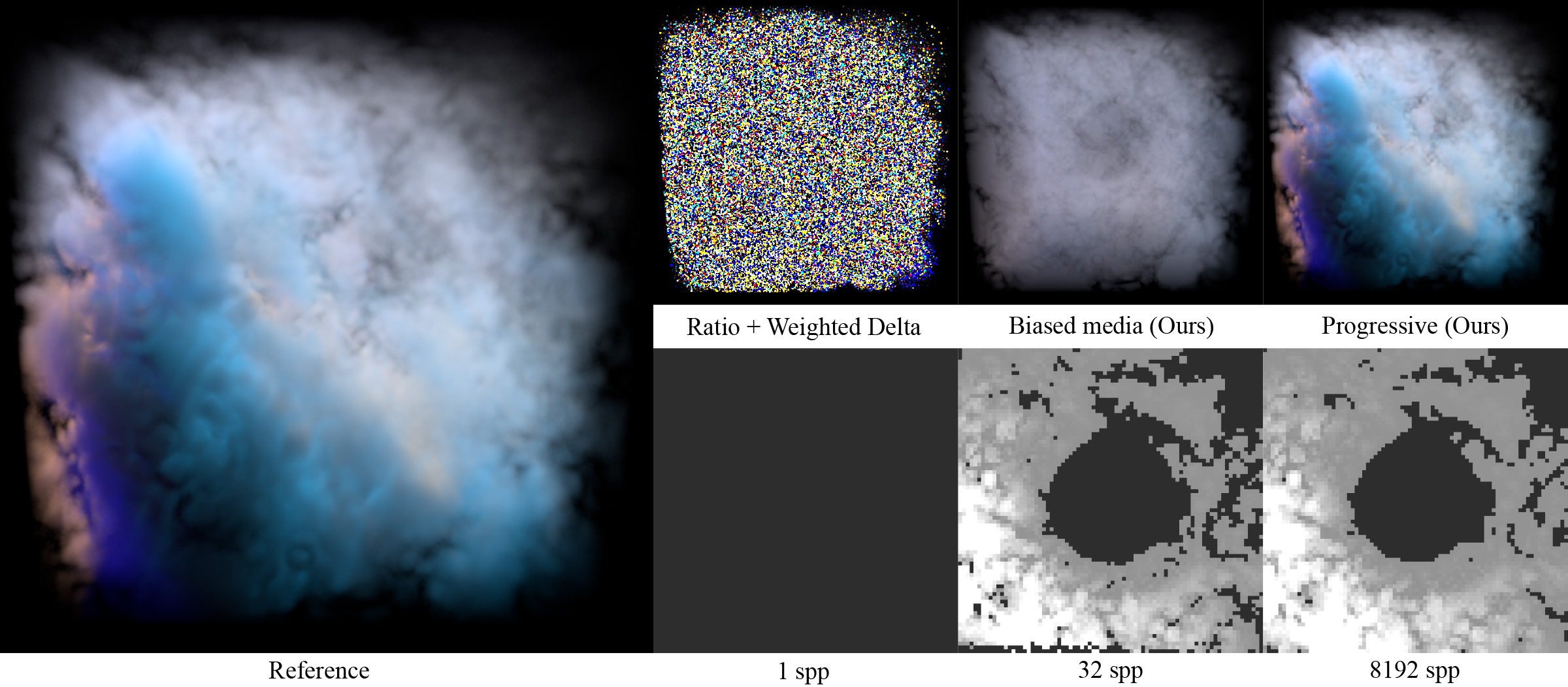
Null-collision approaches for estimating transmittance and sampling free-flight distances are the current state-of-the-art for unbiased rendering of general heterogeneous participating media. However, null-collision approaches have a strict requirement for specifying a tightly bounding total extinction in order to remain both robust and performant; in practice this requirement restricts the use of null-collision techniques to only participating media where the density of the medium at every possible point in space is known a-priori. In production rendering, a common case is a medium in which density is defined by a black-box procedural function for which a bounding extinction cannot be determined beforehand. Typically in this case, a bounding extinction must be approximated by using an overly loose and therefore computationally inefficient conservative estimate. We present an analysis of how null-collision techniques degrade when a more aggressive initial guess for a bounding extinction underestimates the true maximum density and turns out to be non-bounding. We then build upon this analysis to arrive at two new techniques: first, a practical, efficient, consistent progressive algorithm that allows us to robustly adapt null-collision techniques for use with procedural media with unknown bounding extinctions, and second, a new importance sampling technique that improves ratio-tracking based on zero-variance sampling.
Downloads
Publication
Slides
Code
Videos
Fast forward slides video
Acknowledgements
The cloud model in Fig. 9 is from Walt Disney Animation Studios. This work was generously supported by NSF award 1844538.
Cite
Zackary Misso, Yining Karl Li, Brent Burley, Daniel Teece, Wojciech Jarosz. Progressive null-tracking for volumetric rendering. ACM SIGGRAPH Conference Papers, July 2023.@inproceedings{misso23progressive,
author = {Misso, Zackary and Li, Yining Karl and Burley, Brent and Teece, Daniel and Jarosz, Wojciech},
title = {Progressive null-tracking for volumetric rendering},
booktitle = {ACM SIGGRAPH Conference Papers},
year = {2023},
month = jul,
doi = {kmdw},
keywords = {participating media, transmittance, null collision, null scattering, stochastic sampling, Monte Carlo
integration}
}
Related Projects
- 2019 Paper: A null-scattering path integral formulation of light transport
- 2019 Paper: Integral formulations of volumetric transmittance
- 2018 Paper: Monte Carlo methods for volumetric light transport simulation
- 2014 Paper: Residual ratio tracking for estimating attenuation in participating media