Practical Gaussian process implicit surfaces with sparse convolutions
In ACM Transactions on Graphics (Proceedings of SIGGRAPH Asia), 2025

Abstract
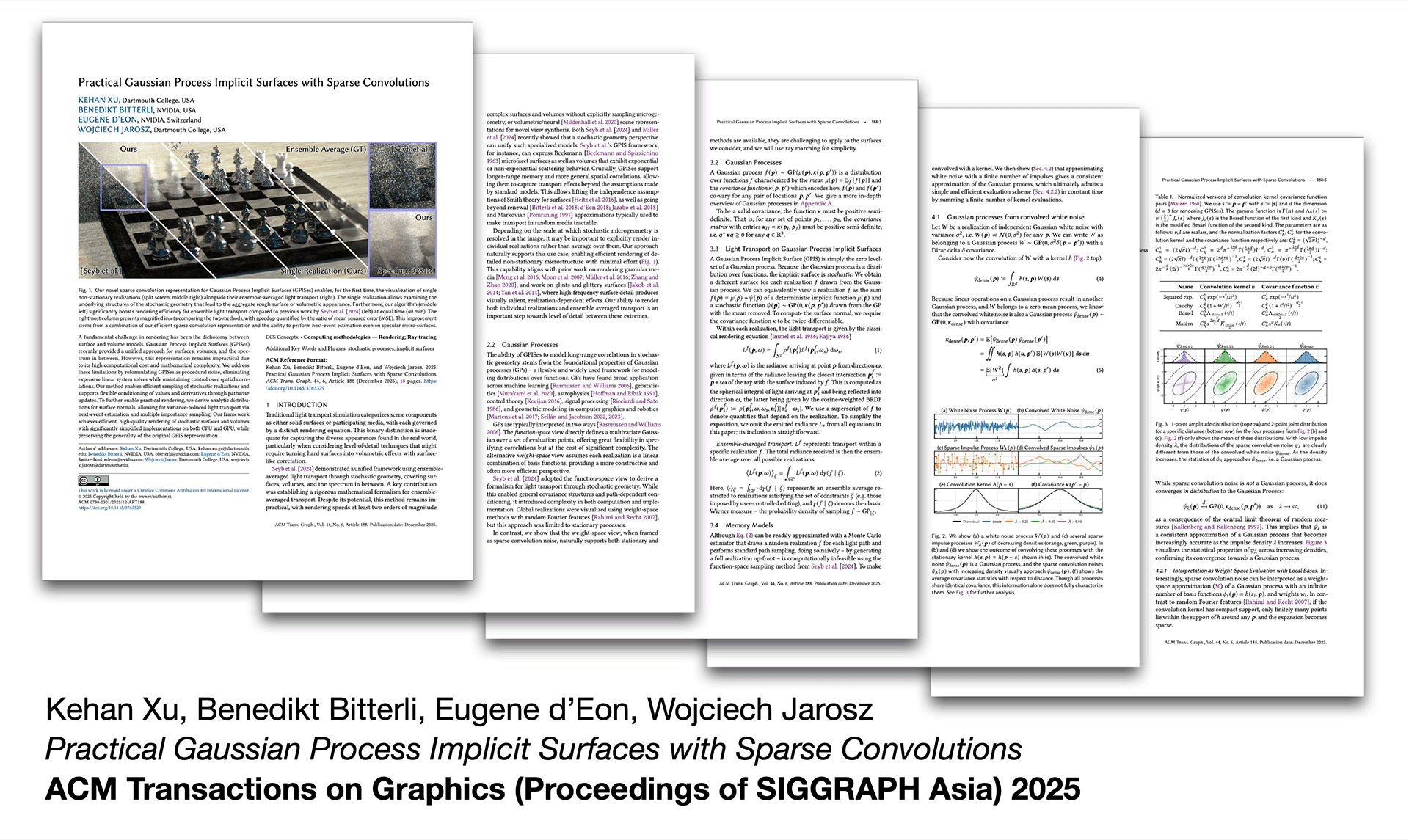
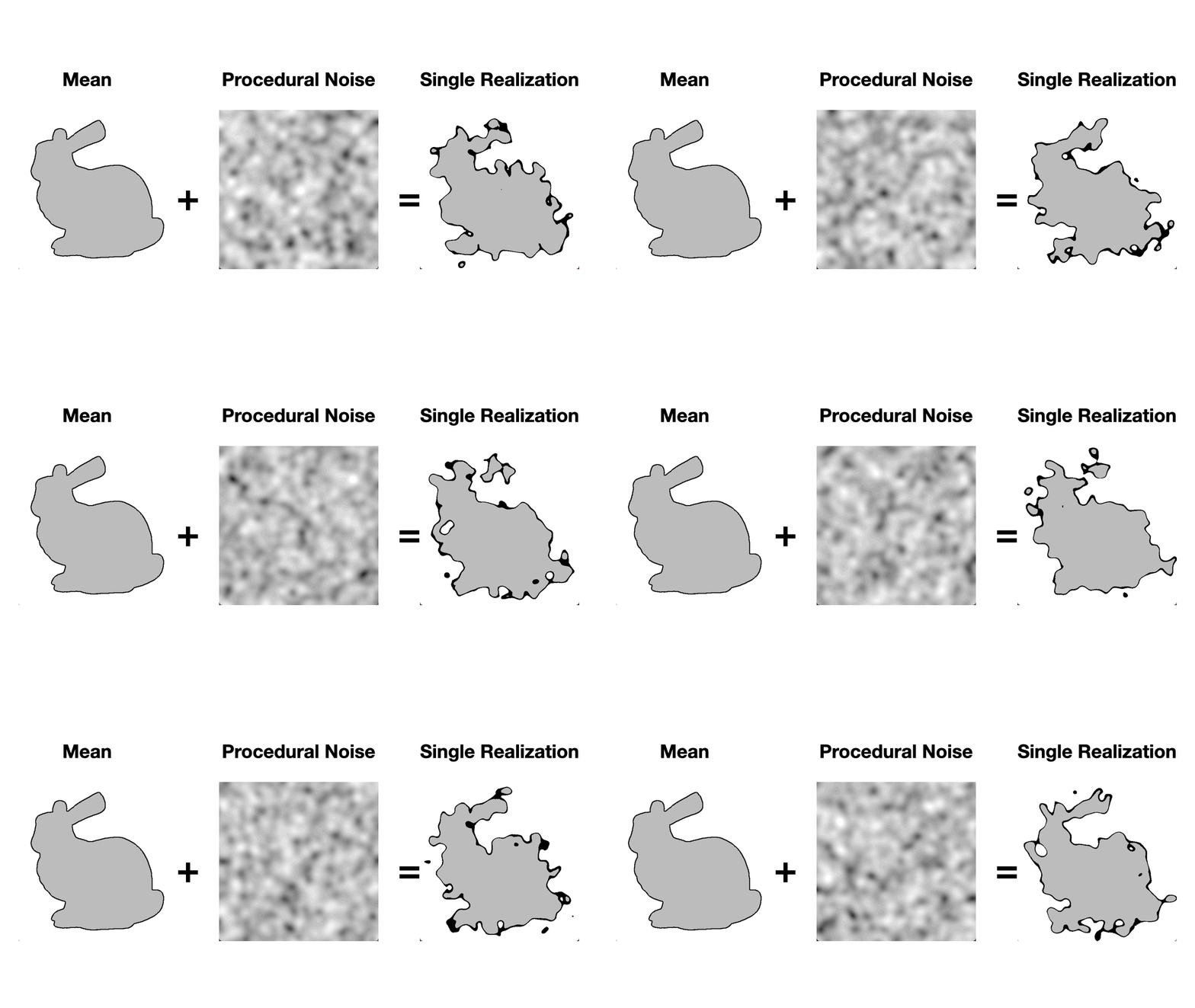
A fundamental challenge in rendering has been the dichotomy between surface and volume models. Gaussian Process Implicit Surfaces (GPISes) recently provided a unified approach for surfaces, volumes, and the spectrum in between. However, this representation remains impractical due to its high computational cost and mathematical complexity. We address these limitations by reformulating GPISes as procedural noise, eliminating expensive linear system solves while maintaining control over spatial correlations. Our method enables efficient sampling of stochastic realizations and supports flexible conditioning of values and derivatives through pathwise updates. To further enable practical rendering, we derive analytic distributions for surface normals, allowing for variance-reduced light transport via next-event estimation and multiple importance sampling. Our framework achieves efficient, high-quality rendering of stochastic surfaces and volumes with significantly simplified implementations on both CPU and GPU, while preserving the generality of the original GPIS representation.
Downloads
Publication
Slides
Video
Data
- Supplemental archive, ZIP (140MB) - offline version of the interactive comparisons below including both EXR and PNG images.
Code
Videos
Video (full-quality)
Video (web-quality)
Presentation slides video
Visual overview



Interactive result comparisons
Below you can view interactive comparisons of the full OpenEXR rendered results from the paper (or, if you prefer, the low-dynamic range PNG versions are linked below each thumbnail)

(LDR version)

(LDR version)

(LDR version)

(LDR version)

(LDR version)

(LDR version)

(LDR version)
Acknowledgements
We thank Dario Seyb for insightful discussions on GPIS and Jeffrey Liu for providing helpful feedback. This work was partially supported by NSF awards 1844538 and 2440472. We used assets licensed under CC0 in many figures of this paper and thank the original creators for providing them: shader ball [Takikawa et al. 2022], chess set (polyhaven.com, by Riley Queen), dragon (OpenVDB sample models), two statues (threedscans.com), and coffee mug (Sketchfab). We pair-programmed with an LLM to refine the code and layout of several programmatically generated figures: Figs. 2, 3, 5, 6 and 19.
Cite
Kehan Xu, Benedikt Bitterli, Eugene d'Eon, Wojciech Jarosz. Practical Gaussian process implicit surfaces with sparse convolutions. ACM Transactions on Graphics (Proceedings of SIGGRAPH Asia), 44(6), December 2025.@article{xu25practical,
author = {Xu, Kehan and Bitterli, Benedikt and d'Eon, Eugene and Jarosz, Wojciech},
title = {Practical {G}aussian Process Implicit Surfaces with Sparse Convolutions},
journal = {ACM Transactions on Graphics (Proceedings of SIGGRAPH Asia)},
year = {2025},
month = dec,
volume = {44},
number = {6},
doi = {10/hbv37h}
}
Related Projects
- 2024 Paper: From microfacets to participating media: A unified theory of light transport with stochastic geometry
- 2018 Paper: A radiative transfer framework for non-exponential media
- 2016 Paper: Efficient rendering of heterogeneous polydisperse granular media
- 2015 Paper: Multi-scale modeling and rendering of granular materials